
TwoBlue · Execute · Sea
Trident. Autonomy at sea.
Trident runs the mission on board UUVs, USVs, buoys and seabed nodes. It executes the Poseidon mission package autonomously, adapts within the limits it was given, and sends progress, observations and outcomes home over telemetry.
10
contacts held at once in passive TMA
10
mission types, plus composite
Low-power
runtime on the platform
Features
What Trident does.
Rules of the Road anti-collision
Anti-collision under the Rules of the Road (COLREGs), while keeping to the mission.
Autonomous navigation
Decides its own 3D route and next waypoint over the real seabed. Position comes from GPS, AIS or other navigation aids.
Diving and surfacing
Dives to the depth each task needs and comes up for comms windows, within the limits Poseidon set.
Mission execution
Runs the whole Poseidon mission package and adapts search patterns, sensor use, local route and depth where the mission allows.
Store and forward communications
Progress and observations are held on board and sent home at each comms window.
Use cases
Where Trident is used.
Operations despite poor communications
Keeps working the mission when the link drops, and reports at the next comms window.
Operations in unknown areas
Works where charts and observations are sparse, adapting its local route within the limits Poseidon set.
Autonomy for legacy platforms
Runs on board existing UUVs, USVs, buoys and seabed nodes, giving them autonomous mission execution.
Fail-safe return home
Energy, lost-link and equipment-fault fail-safes bring the vehicle home. In Manual they warn, and the operator decides.
Illustrative animations, not recordings of real missions.
Illustrative scenario
Route clearance off a busy coast
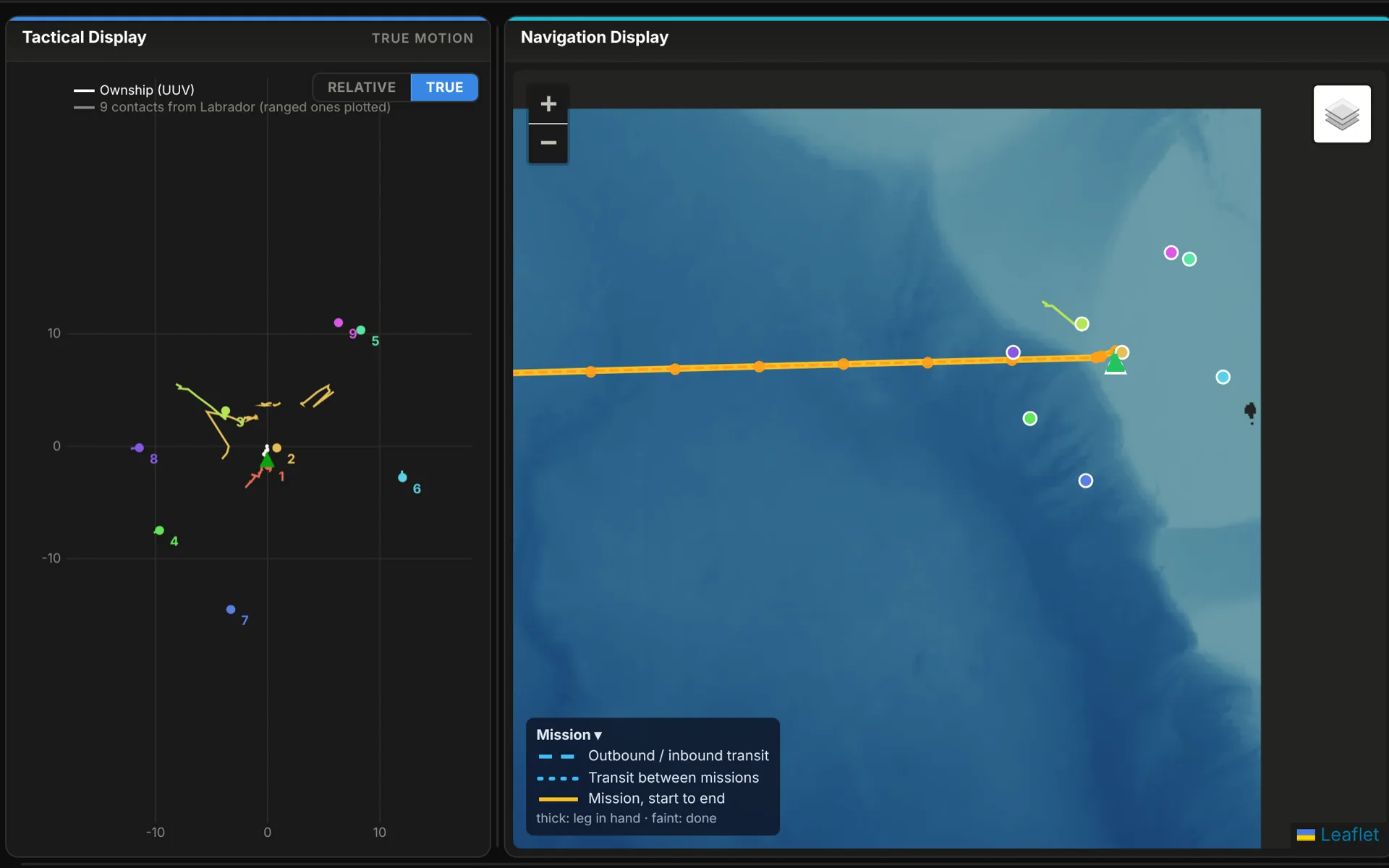
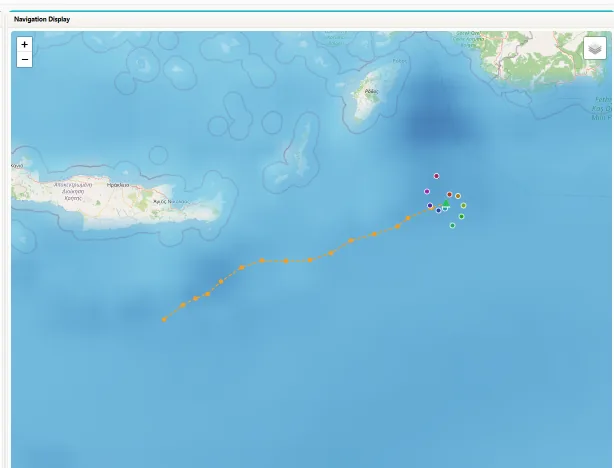
A Trident UUV leaves harbour on a route clearance task. It transits under the Rules of the Road, holds ten contacts in its passive tracker, eases its local route around a fishing fleet within the limits Poseidon set, surveys the route, sends progress home and brings the full data set back at the end.
Missions
Ten mission types, run autonomously.
Every mission collects data. Whatever the mission, the vehicle records its sensors the whole way: positions, contacts, acoustic, magnetic and optical data, and environmental measurements such as temperature, salinity and currents, plus any other information the customer needs. Everything goes into the on-board data recorder. Short updates come home during the mission. At the end, the full data set comes home over the high-bandwidth link, with a tamper-evident, sealed mission report. Encryption with commercially available or customer-provided software is optional. On Surveillance, collecting data can be the aim itself, with your own payload on board.
01
Surveillance
Watch a point, a route or boundary, or an area over long periods.
02
Mine Hunting
Find, classify and re-inspect mine-like objects on the seabed and in the water column.
03
Route Clearance
Survey a route and declare it clear, or show what is left to resolve.
04
Searches
Find contacts, objects or people in distress.
05
Shadowing
Follow a contact to locate, classify and identify it.
06
Infrastructure Inspection
Close passes to find damage or change.
07
Photographic Survey
Georeferenced imagery of a defined area.
08
Decoy
Present a prescribed signature, on time and in place.
09
Bottoming / Loitering
Hold station on or near the seabed, or on station in the air.
10
Swarm Deployment
Many platforms, coordinated roles and routes.
+
Composite & multi-sensor
Chain mission types into one plan.
In the air
The same mission engine flies as Zeus.
Zeus brings Trident’s mission engine to fixed-wing and multirotor UAVs. Poseidon plans both and keeps sea and air deconflicted.
For AUVs
Underwater sensing and data transfer nodes.
Nodes on the seabed or in the water column that add sensing and data transfer for AUVs running Trident.
Trident Vessel Emulator
Two complete autonomous platform simulations for training, testing and integration before you go to sea.
Works with
Part of TwoBlue.
Brochure
Trident in three pages: features, use cases and screens.
Takes its mission from Poseidon. Gets contacts from Labrador Edge on board. Rehearse it first in the Trident Vessel Emulator.
Put Trident on your platform.
Talk to us about integration.
Screens from TwoBlue software running demo scenarios with simulated and emulated data. Scenarios are illustrative.
Privacy first. This website does not track you: no analytics, no advertising or tracking cookies, no visitor recording. We only see what you choose to send us.